

The True ROI of Corporate Travel
How High-Performing Travel Programs Drive Revenue, Control Costs, and Create Measurable Business Value
Corporate travel is no longer a discretionary cost—it’s a strategic investment. When managed with the right data, governance, and insights, business travel delivers measurable ROI across revenue growth, cost efficiency, risk mitigation, and employee performance.
This guide goes beyond surface-level savings metrics to explain how ROI is actually created inside modern corporate travel programs, where value leaks out, and how leading organizations use unified travel data to capture it.
Why “ROI of Corporate Travel” Needs a New Definition
For years, corporate travel ROI was narrowly framed as cost reduction: negotiated airline discounts, hotel rates, and policy enforcement. That lens is now incomplete—and often misleading.
Today’s ROI equation includes four interconnected value pillars:
Cost Control & Leakage Reduction

Revenue Enablement & Growth

Operational Effiency & Risk Management

Employee Productivity, Retention & Experience

High-performing programs measure and optimize all four, using accurate, unified travel data as the foundation.
Cost Control — Finding the Hidden Leakage
Most corporate programs overspend not because of high travel volume, but because of data blind spots.
The 5 Biggest Sources of Travel Spend Leakage
1. Out-of-Policy Bookings
Caused by poor policy design, lack of real-time enforcement, or fragmented booking channels.
2. Low Preferred Supplier Compliance
Negotiated rates deliver no ROI if travelers don’t use them—and many programs can’t accurately measure compliance.
3. Unreconciled & Misclassified Spend
Manual reconciliation across cards, invoices, and booking systems leads to errors, write-offs, and lost savings.
4. Unused Tickets & Credits
Millions in airline credits go unused each year due to poor tracking and ownership.
5. Shadow Travel & Off-Channel Spend
Bookings outside the managed program inflate risk and hide true program costs.
Key insight:
Most leakage isn’t behavioral—it’s structural, driven by fragmented data and outdated workflows.
Identify your leakage points → Discover graspINSIGHTS for Corporate Travel Teams
Operational Efficiency, Risk & Compliance
ROI isn’t just about spend—it’s about how efficiently and safely the program runs.

Operational ROI drivers
Automated reporting vs. manual data wrangling
Fewer exceptions and escalations
Faster month-end close for travel and payments
Reduced audit and compliance risk

Risk & duty of care
Incomplete traveler visibility increases exposure during disruptions
Payment fraud and card misuse add hidden costs
Inaccurate data undermines compliance reporting

Programs with unified data consistently:
Reduce manual effort by 30–50%
Improve policy compliance without adding traveler friction
Strengthen duty-of-care readiness with real-time visibility
Download our Free Business Travel ROI Calculator
Revenue Enablement — Travel as a Growth Engine
Business travel directly supports revenue in ways traditional expense reports can’t capture.
Where the ROI comes from
In-person sales meetings close deals faster and at higher values
Client visits increase retention and lifetime value
Travel enables market expansion, partnerships, and deal recovery
Executive and technical teams gain real-world insights impossible to replicate virtually

Industry signals
B2B organizations consistently report higher close rates for deals involving in-person meetings versus virtual-only engagement
Strategic travel correlates with faster pipeline velocity and stronger customer relationships

The Measurement Challenge
Revenue impact is rarely tagged back to travel spend because:
CRM, sales data, and travel data live in separate systems
Travel data lacks consistent trip purpose and traveler attribution
Finance teams see cost, not contribution
How leading programs respond
They connect trip intent, traveler role, and outcomes—turning travel from a cost center into a revenue-enabling asset.
See how unified data enables revenue attribution → Explore graspCORPORATE DATA SERVICES
Employee Productivity, Retention & Experience
Travel impacts employees more than almost any other corporate process.

Positive ROI signals
Faster onboarding and skills transfer
Stronger cross-team collaboration
Higher engagement and retention

Negative ROI signals
Friction-filled booking and reimbursement processes
Inconsistent traveler experience
Poor support during disruptions

Organizations that simplify travel workflows and reduce friction see:
Higher program adoption
Better policy compliance
Lower burnout among frequent travelers
The Role of Data: Why Most Programs Can’t Prove ROI
The biggest barrier to measuring ROI isn’t lack of intent—it’s bad data
Common data challenges
Multiple booking tools and agencies
Disconnected payment, expense, and ERP systems
Inconsistent traveler, supplier, and policy data
Manual spreadsheets and one-off reports
Without clean, normalized, and unified data:
ROI calculations are incomplete
Executive reporting lacks credibility
Optimization decisions are reactive, not strategic
Modern ROI requires a single source of truth for travel data.
Build your ROI foundation → Learn about graspCORPORATE INSIGHTS
Trusted by Leading Enterprises





A Practical Framework: How to Measure Corporate Travel ROI
Step 1:
Establish Baselines
Total managed vs. unmanaged spend
Policy compliance rate
Supplier attachment and utilization
Manual effort required for reporting and reconciliation
Step 2:
Identify Value Levers
Revenue-enabling travel categories
High-leakage spend areas
Operational bottlenecks
Risk and compliance gaps
Step 3:
Quantify Impact
Cost avoided or recovered
Time saved (converted to labor value)
Improved compliance and risk reduction
Revenue influence indicators
Step 4:
Communicate ROI
Executive-ready dashboards
Narrative insights, not just charts
Clear “before vs. after” benchmarks
FAQs: Corporate Travel ROI
What is the ROI of corporate travel?
Corporate travel ROI measures the total business value generated by travel—including revenue growth, cost savings, efficiency gains, and employee impact—relative to total travel spend.
How do companies calculate travel ROI?
Leading organizations combine travel data with finance, sales, and operational metrics to assess cost control, revenue enablement, productivity, and risk reduction.
Is corporate travel still worth it?
Yes. When managed with accurate data and clear objectives, corporate travel consistently delivers measurable business value that exceeds its cost.
What data is required to measure travel ROI?
Unified booking, payment, policy, traveler, and supplier data—normalized and reconciled across systems.
How does technology improve travel ROI?
Modern analytics platforms automate reporting, reduce leakage, improve compliance, and surface insights that drive better decision-making.
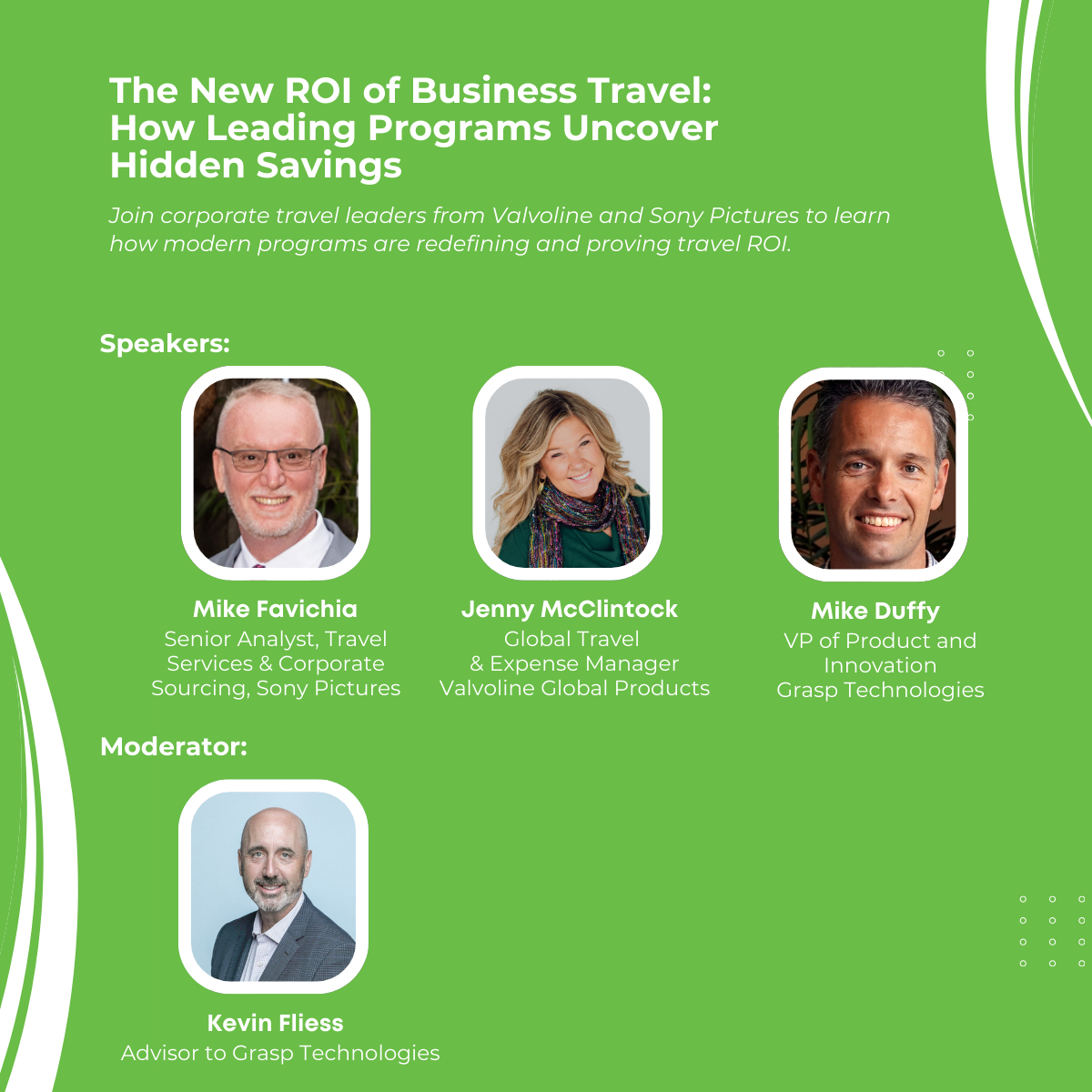
Watch our Webinar on the ROI of Business Travel
“The future of travel ROI isn’t about spending less. It’s about seeing more, acting faster, and aligning everyone around the same truth…ROI stops being a debate and starts being something you can see, measure, and explain.”
Download our Free Business Travel ROI Calculator
Turn Travel Into a Measurable Advantage
Corporate travel ROI isn’t theoretical—it’s measurable, repeatable, and improvable when powered by the right data.
Next steps
This page is part of Grasp’s 2026 thought leadership series on maximizing the ROI of corporate travel programs.