
Thirty Years of Grasp: A Founder’s Story
By Erik Mueller
When people ask how Grasp started, the honest answer is: it wasn’t part of some master plan. It grew out of curiosity, frustration with the status quo, and a lot of late nights trying to solve real problems for real customers.
Thirty years later, when I look back, I see three distinct chapters—each shaped by the technology of the moment and the lessons we learned along the way.
The Beginning: Solving a Problem (1996–2006)
Before starting Grasp, I was working in corporate travel technology. At the time, the industry was going through major upheaval—commission cuts, consolidations, and constant change. I remember thinking, I’m done with travel. I’m going to start a company in a “real” industry.
So I launched an IT services firm.
Ironically, my first client turned out to be a travel company. They prepaid a year of consulting work up front, which gave me the capital to get started. My job was helping them automate reporting and analyze their data—things most agencies were doing manually.
That’s when I saw the opportunity.
Travel agencies were paying enormous amounts of money for back-office reporting systems, yet the tools were still primitive. Meanwhile, the internet was just starting to change how information could move between systems. Most companies were literally shipping disks with data.
So we tried something different.
Instead of shipping disks, we began transmitting data over the internet using FTP. It seems obvious now, but at the time it was groundbreaking for the travel industry. That experiment eventually became secureConnect (now graspSYNC), the data transmission platform that still powers Grasp today.
Around the same time we built our first reporting tools, what eventually became graspDATA. Travel agencies immediately understood the value: finally, they could actually see their data in a meaningful way.
That was our first real product-market fit.
By the early 2000s we moved fully to web-based reporting. Growth followed quickly. Within a few years we had dozens of clients, then hundreds. Many of the largest corporate travel departments (CTDs) were using our platform.
But even with the growth, we were barely keeping up.
We were working around the clock…literally. I remember coding for two or three days straight, hallucinating from exhaustion. At the time we thought the solution to every problem was simple: work harder.
Eventually we learned that wasn’t sustainable.
Growing Up as a Company (2006–2016)
The next decade was about scaling, and realizing how hard scaling really is.
One of the pivotal moments came in 2007 when Virtuoso approached us. They had just partnered with Mastercard and needed a way to track how customers were shifting spending from one card network to another.
We built the data infrastructure to do it.
That contract changed everything. Suddenly we went from selling small subscriptions to travel agencies to supporting large global organizations and handling massive data volumes. It was also the first real step toward what we now call data services.
Soon after, Mastercard approached us directly, followed later by Visa.
At the same time our core agency business kept growing. We were adding new customers every month. For years it felt like a constant rhythm—more agencies, more data, more complexity.
But internally, the company was chaotic.
We had no processes. No structured onboarding. Our HR handbook was barely a few pages long. Everything depended on whoever happened to be available that day.
Eventually we realized something had to change.
We actually paused sales for nearly a year so we could rebuild the company operationally. We focused on hiring, processes, and leadership development. Personally, that was a huge shift for me. In the early years, I was the company. Nothing happened unless I did it.
Learning to delegate was one of the hardest lessons of my career.
During that time I joined CEO groups like Vistage and the Entrepreneurs’ Organization. Talking to other founders helped me realize that the struggles we were facing were completely normal.
It was a turning point.
By the mid-2010s we had a stronger leadership team, better processes, and a clearer sense of how to run the company.
The Inflection Point (2016–Today)
After twenty years, something changed.
For most of Grasp’s history, I could always see the next step. The next product. The next opportunity. The direction felt obvious.
Then suddenly it didn’t.
We had built a successful company with loyal customers and consistent growth. But I couldn’t clearly see how we would jump from a solid mid-sized business to the next stage.
I believed the future was still data—it always had been—but I couldn’t see the exact path to get there.
Then COVID hit.
Like every company in travel, we faced uncertainty. But something remarkable happened. We stayed profitable, kept our team together, paid off our debt, and even continued growing. I’m incredibly proud of how our people handled that period.
Around that time we partnered with WaveRock Capital. Their philosophy matched ours: build great companies and hold them for the long term. They brought capital and resources that allowed us to think bigger about the future.
Eventually we also brought in outside leadership to help guide the next stage of the company. Stepping back from the day-to-day operations wasn’t easy—Grasp had been my life for decades—but it allowed me to see the company from a new perspective.
Having a leader like Chris Wilson at the helm—who brings deep experience from much larger organizations, including Oracle—has been an important step in Grasp’s evolution. Chris understands what it takes to scale technology companies, build strong teams, and position products for global growth. His leadership is helping us take the foundation we built over the past thirty years and prepare it for the opportunities ahead.
Now I get to contribute from a strategic level rather than trying to do everything myself.
What I’m Most Proud Of
When I think about Grasp today, I’m proud of the technology we built—but I’m even more proud of the relationships.
Our customer retention is extraordinary. Many of our earliest clients are still with us decades later. That doesn’t happen unless you genuinely care about the people you work with.
From the beginning, our philosophy was simple:
Take care of employees.
Take care of customers.
Everything else follows.
That mindset became part of the company’s DNA.
What I’ve Learned
Over thirty years, we’ve changed how we build, how we lead, and how we scale.
But we’ve never changed why we exist.
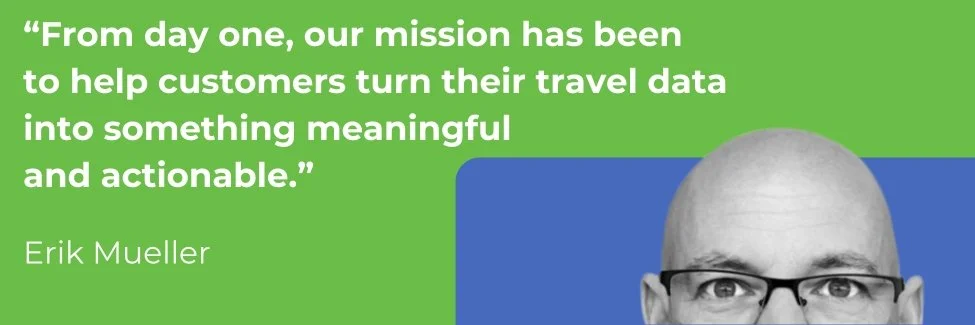
From day one, our mission has been to help customers turn their travel data into something meaningful and actionable. Everything else, the products, the structure, the strategy, has evolved around that core idea.
The Next Thirty Years
If the last thirty years were about the internet and the rise of data, the next thirty will be about AI and automation.
The pace of innovation right now reminds me of the late 1990s. The technology is exploding with possibilities, but most companies are still figuring out how to apply it.
The opportunity for Grasp is the same opportunity we saw decades ago: help customers make sense of their data and turn it into something actionable.
We have hundreds of customers using our platform today. Among them are innovators—people who already know where they want to go with the next generation of technology.
Our job is to find them, partner with them, and build the future together.
If I could start over today, knowing what I know now, I’d probably build the company very differently.
But I wouldn’t change the journey.
Because the truth is, Grasp has always been about the same thing it was on day one: helping our customers succeed.
And after thirty years, we’re just getting started.
