
Only 12% of global companies have a consolidated view of their travel program from a single data source, according to GBTA's 2026 travel buyer survey. For TMCs, that gap is both a problem and an opening.
Your clients want unified reporting, and they're watching your operations closely. In the same survey, buyers gave servicing nearly as much weight as technology (46% vs. 54%) when choosing a TMC. Efficiency is now part of how clients judge you, not just how you protect margin.
So what does "efficient" look like going into 2027? Below are the benchmarks worth tracking, where the numbers stand today, and where most of the waste hides.
The 2027 benchmarks
Six metrics tell you most of what you need to know about operational efficiency. Where GBTA's 2026 survey gives an industry reference point, it's listed below.
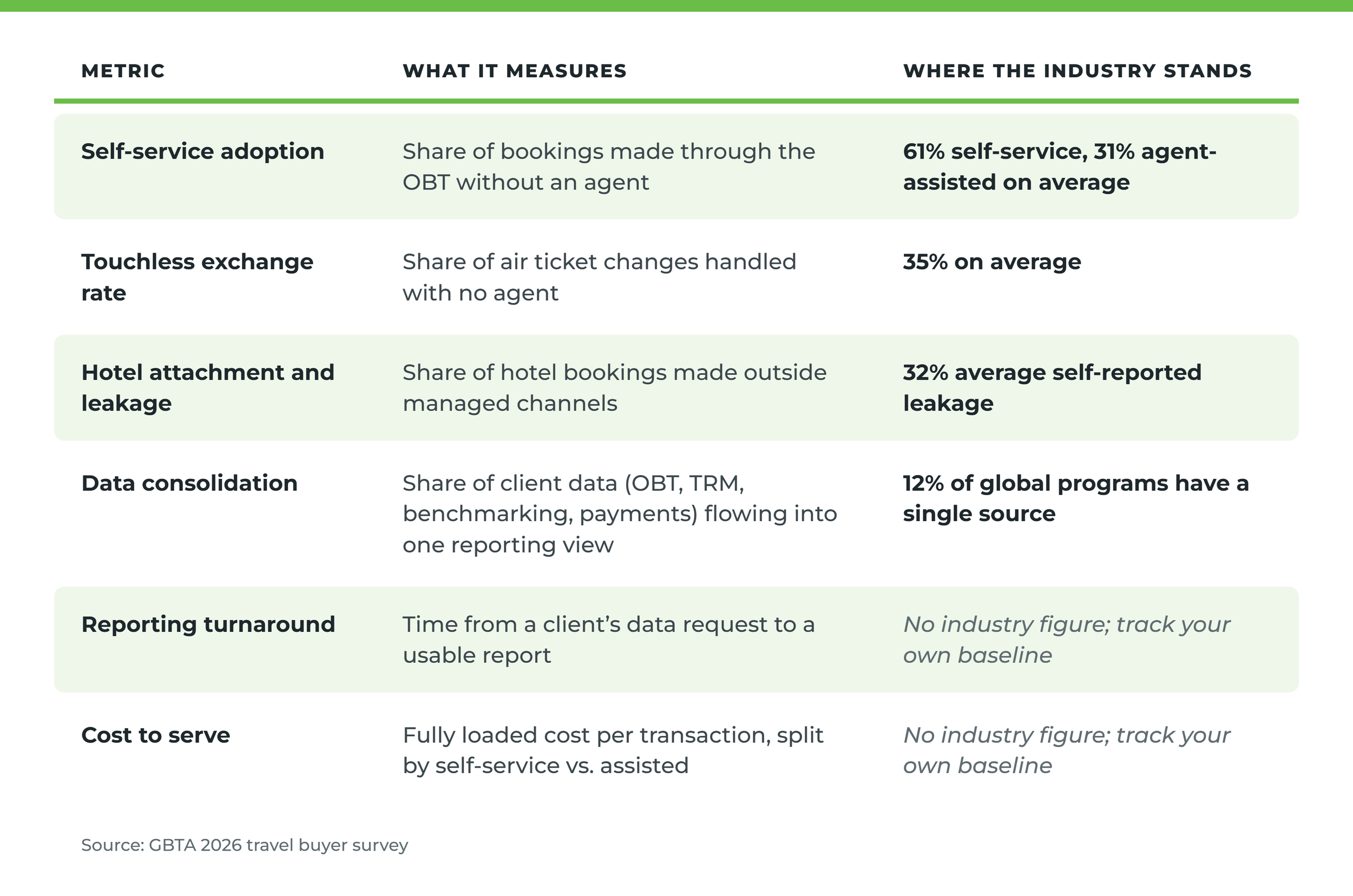
The first three show how much work still lands on your agents. The last three show how much work lands on your back office, and that's where the next round of gains is.
Where efficiency leaks
Most TMC inefficiency isn't in booking. It's in the hours spent stitching data together after the trip.
A single client's travel data can live in the GDS, NDC channels, one or more online booking tools, card and payment feeds, and expense systems. Each source uses different formats and timing. Someone on your team reconciles it by hand before any report goes out.
Your clients feel this too. Among buyers running global programs, the top challenge GBTA found was a lack of consolidated reporting across regions (63%). Only 32% say their TRM data flows into a central platform, and just 26% say the same for their benchmarking tools.
Every manual reconciliation step adds cost, slows reporting, and leaves room for error. It also makes your benchmarks harder to trust, because you can't measure what you can't see in one place.
How to benchmark yourself in 2027
Set a baseline in Q1. Pull last year's numbers for all six metrics, client by client. Gaps in the data are a finding in themselves.
Compare against the industry. Use the GBTA figures above as a starting reference, then look at how your best and weakest accounts differ.
Pick two metrics to move. Trying to improve everything at once spreads effort thin. Touchless exchanges and reporting turnaround are often the fastest wins.
Fix the data before the dashboard. Normalize and consolidate your sources first. A dashboard built on fragmented data just shows the fragmentation faster.
Review quarterly and share results with clients. Showing clients measurable progress strengthens renewals and sets you apart in RFPs.
Data as a service: the efficiency layer most TMCs are missing
Data as a service (DaaS) means a partner collects, cleans and consolidates your travel data and delivers it ready to use. Your team works from one trusted source instead of building and maintaining that source themselves.
For TMCs, this addresses the problem behind most of the benchmarks above. Self-service rates and touchless exchanges depend on your booking tech. Reporting speed, data consolidation and cost to serve depend on your data.
How it works
Connect. Data flows in from GDS and NDC channels, online booking tools, and card and payment feeds.
Normalize. Records are standardized, matched across sources, and checked for errors and gaps.
Deliver. Clean, consolidated data reaches your team and your clients through dashboards, scheduled reports or feeds into your own tools.
What changes for your benchmarks
Data consolidation: Client data that was spread across separate systems becomes one normalized view per client.
Reporting turnaround: Days of manual pulls and reconciliation give way to reports built from data that's already clean.
Cost to serve: Back-office hours stop growing with every new client, because data work scales without adding headcount.
Hotel leakage: Card and payment data helps reveal spend happening outside managed channels.
Client retention: Reporting stops being a cost center and becomes a reason to renew.
Why buy rather than build
Building this in-house means dedicated data engineers, constant upkeep as suppliers and NDC connections change, and months before clients see any benefit. A DaaS partner already maintains those connections, so your team can focus on servicing and advising clients.
For TMCs, that partner is graspDATA. It’s Grasp’s data-as-a-service solution, built to connect, normalize and deliver travel data so TMCs can run on a single source without building it themselves.
Turn your data into a competitive edge
The TMCs that pull ahead in 2027 won't just book faster. They'll know their numbers, and they'll give clients one clear view of the program.
graspDATA gives TMCs that single source, so you can set a reliable 2027 baseline, report to clients faster, and prove the value you deliver.
Talk to Grasp about setting your 2027 baseline.
