
How Unified Travel Data Delivers Measurable Savings
In corporate travel, most cost problems aren’t caused by prices; they’re caused by fragmentation. Booking data sits in the GDS, payment data sits in card platforms, expense data lives in finance systems, and reporting is stitched together after the fact.
When booking data lives in one system, expense data in another, payment data somewhere else, and reporting is stitched together manually, organizations lose visibility into what they’re actually spending and why. Travel managers may see airfare totals. Finance may see credit card statements. Procurement may see supplier contracts. But no one sees the complete picture.
Unified travel data changes that completely. By bringing GDS, OBT, TMC back office, card issuer, expense, and operational data into one clean, connected ecosystem, companies gain the clarity they need to control costs, improve compliance, and uncover savings that were always there, just hidden beneath disconnected systems.
The Hidden Cost of Disconnected Travel Data
Many travel programs assume their biggest savings opportunities lie in negotiating better airline or hotel rates. While supplier negotiations absolutely matter, the reality is that much of the financial leakage in travel programs happens after contracts are signed.
Out-of-policy bookings slip through unnoticed. Unused ticket credits expire because no system connects them to future trips. Duplicate or incomplete expense records require manual corrections. Supplier commitments go unmeasured because performance data isn’t centralized. Finance teams spend valuable time reconciling transactions that don’t cleanly align with booking records.
Typical leakage points in corporate travel programs include:
5 - 10% of unused ticket value going unredeemed
10 - 20% policy leakage in booking channels
Significant finance time spent reconciling card and booking data
Individually, these issues may seem manageable. Together, they quietly erode budgets month after month.
When data sits in silos, these problems compound. Travel managers struggle to measure true compliance. Finance teams operate reactively, trying to reconcile incomplete information. Agencies assemble reports manually, often without full context. Decision-making slows down because no one fully trusts the data.
Unified data doesn’t just improve reporting; it fundamentally changes how travel programs operate by replacing guesswork with clarity.
What Unified Travel Data Actually Means
Unified travel data isn’t simply about dashboards or data aggregation. It means creating a single, trusted source of truth across the entire travel lifecycle.
Before the trip, it captures booking behavior, policy compliance, and negotiated rate usage. During the trip, it tracks changes, servicing activity, and disruptions. After the trip, it connects payment data, expense reconciliation, and financial reporting back to the original booking.
When these elements are normalized and connected, organizations can finally see their true cost per trip, not just airfare or hotel in isolation, but the total cost of travel. They can understand spending patterns by department, traveler group, or region. They can measure supplier performance against commitments. They can evaluate agency servicing efficiency and payment timelines.
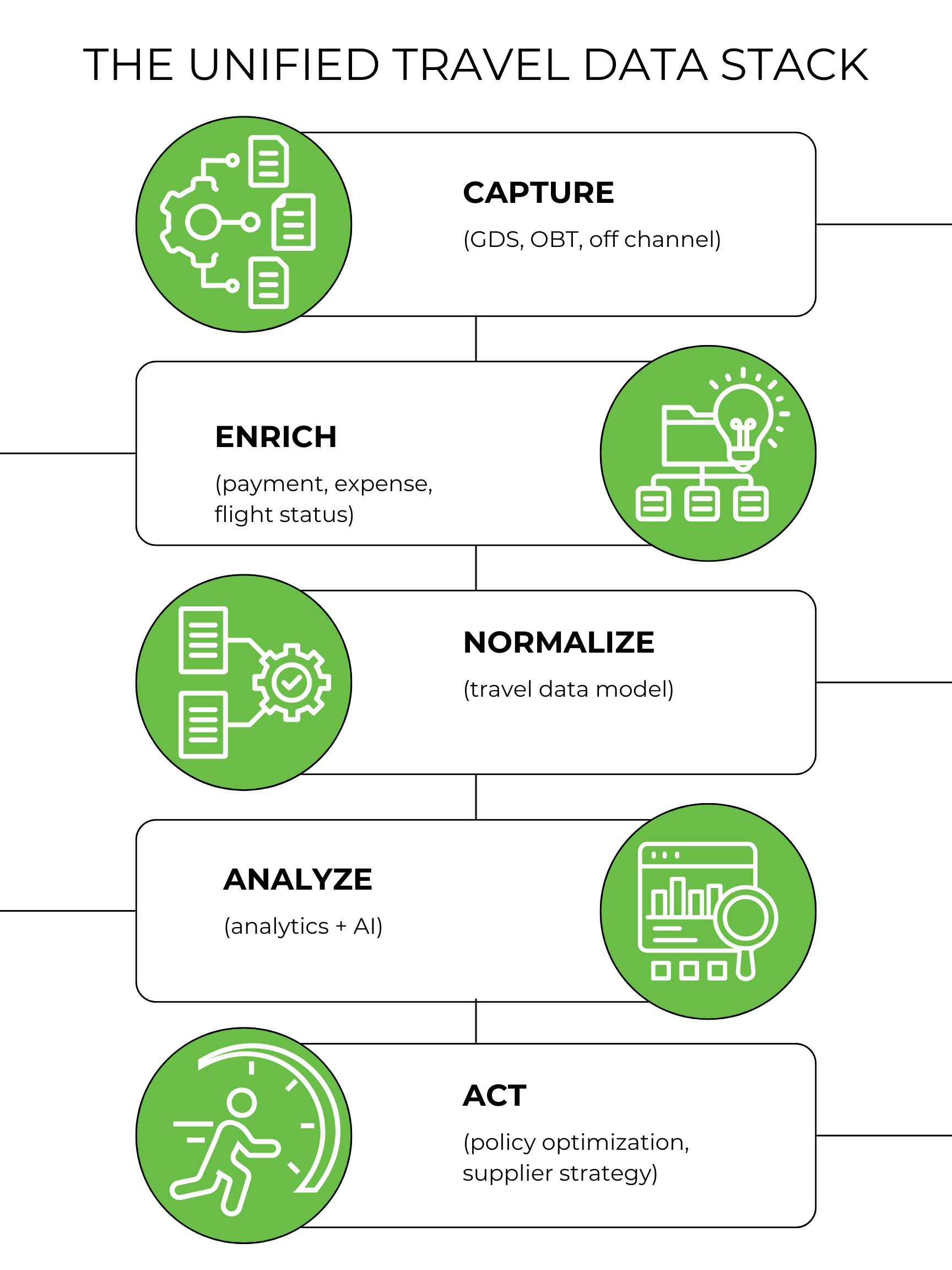
This level of visibility is where meaningful savings begin to emerge.
Watch our webinar on the New ROI of Business Travel
Eliminating Payment and Reconciliation Gaps
One of the fastest ways unified data delivers measurable savings is through payment visibility.
In fragmented environments, booking data and payment data rarely align perfectly. A reservation is made in one system, charged in another, and reconciled somewhere else. When those records don’t match cleanly, finance teams spend days — sometimes weeks — manually reconciling transactions. Errors slip through. Invoices are delayed. Reporting becomes inconsistent.
Solutions like graspPAY bring booking and payment data together from the start. Virtual payment information is directly connected to travel transactions, allowing organizations to see exactly what was booked, what was charged, and how it was processed, all within a unified reporting environment.
The impact extends well beyond operational efficiency. Month-end close cycles accelerate. Payment disputes decline. Manual accounting workload drops. Most importantly, companies gain confidence that their travel spend data is accurate and audit-ready.
When payment data is unified and structured properly, it becomes a strategic asset rather than a reconciliation challenge.
Turning Reporting Into Actionable Intelligence
Most travel programs already generate reports. The problem is that disconnected data often limits those reports to surface-level metrics. They show what happened but don’t explain why, or what to do next.
When travel data is unified and normalized, analytics platforms like graspANALYTICS, provide a much deeper layer of intelligence. Instead of static summaries, travel managers gain dynamic insight into behavioral patterns, compliance trends, and supplier performance.
Unified analytics can reveal whether travelers are consistently booking outside preferred channels, whether specific departments exceed budget norms, or whether negotiated hotel rates are actually being used. It can highlight missed savings opportunities tied to advance booking behavior or identify markets where pricing anomalies drive unnecessary spend.
Because the data is centralized and standardized, leaders can move beyond reactive reporting and begin proactively optimizing their programs. Policies can be refined based on real behavioral data. Supplier negotiations can be informed by measurable performance gaps. Forecasting becomes more accurate because historical data is reliable.
The largest long-term savings don’t come from a single rate reduction. They come from continuous optimization powered by trustworthy insight.
From Visibility to Financial Control
As organizations grow, travel programs naturally become more complex. New offices, new traveler populations, and new payment methods introduce additional layers of data. Without unification, that complexity often leads to higher servicing costs, inconsistent reporting, and reduced compliance.
Unified travel data creates stability in the middle of that growth. When booking, payment, and expense information feed into a centralized analytics environment, leadership can confidently answer critical financial questions. They can measure whether supplier agreements are delivering expected value. They can identify policy gaps before they become systemic. They can monitor cost trends in real time rather than waiting for quarterly reviews.
Perhaps most importantly, unified data builds organizational alignment. Travel managers, finance leaders, and procurement teams operate from the same numbers. Decisions become faster because the underlying information is consistent and trusted.
The Future of Travel Savings Is Data-Driven
Corporate travel programs are under constant pressure to reduce spend, improve compliance, and support better traveler experiences simultaneously. Achieving all three requires more than incremental adjustments. It requires a data foundation that connects every stage of the travel lifecycle.
Unified travel data provides that foundation. By combining structured payment visibility through graspPAY with advanced intelligence powered by graspANALYTICS, organizations can identify inefficiencies that would otherwise remain buried in disconnected systems.
The result is not just clearer reporting. It is stronger financial control, smarter supplier strategy, reduced operational friction, and sustainable cost optimization over time.
Savings rarely appear as dramatic line items overnight. More often, they are unlocked gradually by replacing fragmented processes with unified insight and turning complexity into clarity.
