
30 Questions, 30 years: Part 1 - Built to Last
An interview with Maria Chevalier
As Grasp celebrates 30 years, we sat down with CEO Maria Chevalier to reflect on what has made this company endure—and what will drive its next chapter.
VISION — PAST, PRESENT & FUTURE
Q: Thirty years is rare in travel technology. What has allowed Grasp to stay relevant across so many industry changes?
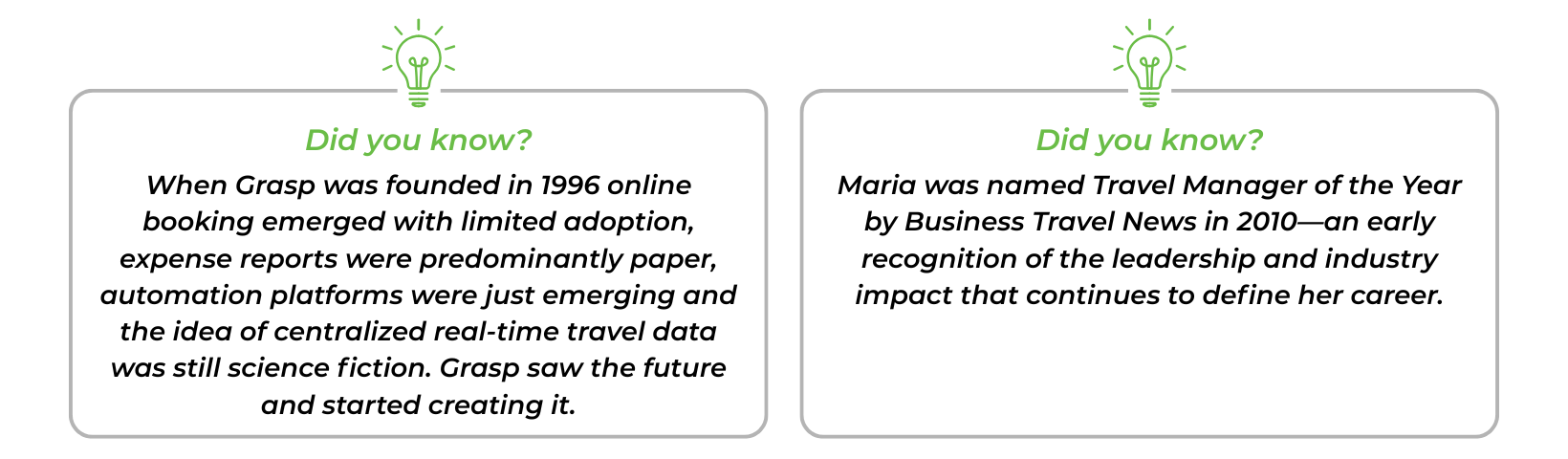
It comes down to fundamentals. Grasp had and has always had a real market differentiation—they knew the value of data long before data “was cool” and a priority for many businesses in the way it is today.
Being a thought leader that early helped establish a strong business, market presence and a customer following.
Then, as the company continued to grow and evolve, one thing became clear: data is the one true, consistent need—in good times and bad. When things are going well, you need it to run the business. When they’re not—when you have something like the COVID pandemic—data becomes even more critical to prepare and understand the pace as well as impact of the recovery.. It rides all the various economic waves and plays a key role in managing the business through all different cycles.

Q: When you look at the next three years, what excites you most about Grasp’s opportunities ?
There’s a lot. But I keep coming back to data—it’s going to become more and more of a critical component. Data keeps you agile. You can change suppliers, change policies, change anything you want—and still keep your data whole. You keep the history, the insights, the value. As we face all these disruptions, planned and unplanned, a central data repository becomes more and more essential.
The other thing I’m excited about is our role as a data integrator. You can choose any operating model you want—work with dozens of different travel agencies if you’d like—and we support that. We ingest it, normalize it, and then give you options: use our reporting platform or integrate directly into your own systems.
Our greatest points of differentiation? We’re independent. We’re not associated with any other entity in the travel ecosystem—that keeps us unbiased. And we are laser-focused on one thing: being the best travel data provider and integrator of all things data.

Q: What will customers need from technology partners that they didn’t need five years ago?
More and more pressure on accuracy, reliability, timing and dependability. Key decisions are made on this data—around safety, security, risk mitigation, customer experience, sourcing, strategy. If that information is wrong, you’re off. And that matters.
The pressure now, more than ever before, is on being able to truly rely on it.
Q: Where do you think the travel industry still underestimates the power of data?
Data is the fuel that powers this industry. And people have accepted—for far too long—that their data is just bad and fragmented. They say it’s crap and they shrug. They accept one source of data and base all their decisions on it. They get worn down trying to separate signal from noise. They accept less than they should when it comes to data. And they shouldn’t.

Q: If we interviewed you again at Grasp’s 35th anniversary, what would you hope has changed most?
One of my core goals is to correct issues at the root cause. I believe we have an obligation to our customers to ensure that their data continuously becomes more reliable, more accurate – so that they can move faster and more confidently when it comes to decision making. We are a data company. And our focus is to provide the best, most reliable, most unified travel data platform in the industry. And, of course, we are very thoughtfully and strategically adding AI into what we do. It will play a critical role—end to end—in helping us improve efficiencies and data quality. The foundation we’re building now is what will make AI truly powerful for our customers down the road.
VALUES — HOW WE WORK
Q: What values matter most to you as a leader?
Integrity. By far. To lead, manage, and live with integrity—that’s what it comes down to. Your reputation is one of the most important assets you have. I’ve lived that my whole life, probably starting as the child of a military father, and it’s threaded through everything I’ve done—personally, professionally, and as a leader. These are followed by empathy, humility as well as passion for learning.

Q: In an industry that moves fast, how do you balance urgency with thoughtfulness?
In some ways we move fast, and in some ways we move slow. You have to balance both. Focus on the key strategies and elements that will support customers and drive the business. You can’t boil the ocean. You can’t do everything. Balance and prioritize—and let the voice of the customer guide.those priorities.
Q: What does trust look like in a company-customer relationship?
I’ve been on all sides of this ecosystem and no matter which side I’m on, trust is critical to a successful relationship – as is one based on mutual respect. The best relationships are the ones where you forget who’s the customer and the supplier. You become so ingrained with each other’s shared success that the lines disappear. You genuinely care and are invested in mutual success and alignment on how to get there together. It is also critical to surround yourself with the best talent as it helps to drive the best from everyone involved.
I’ve had that many times in my career, and those relationships are priceless, memorable and very successful.
Q: What kind of culture are you determined to build at Grasp?
I want to build on the great culture we have at Grasp – one that is defined as client-obsessed not product-obsessed, focused on innovation with purpose, continuous learning challenging the status quo, simplifying complexity, and collaboration over ego.
I want to build a fearless culture that challenges us to be better in everything we do.

Q: What’s one leadership lesson you’ve learned the hard way?
Play to your super powers!
One leadership lesson I learned the hard way is that great leaders scale their strengths - they don’t spend all their energy trying to fix every weakness.
Early on in my career I believed it meant being good at everything. I spent too much time trying to improve areas that drained my energy instead of doubling down on things that naturally created impact.
What I realized – Your superpowers are usually where you create disproportionate value for the company, team and yourself.
→ Want to see where Grasp is headed next?
